15, Jeevan Jyot Society, Opp.Indra Complex, Lalbaug Road, Vadodara-390011
 archit@architelectricals.com
 +91 265-2655380

Transformers are essential for industrial power distribution, and their reliable operation depends on more than…
- Product Guide
- 7 minute read
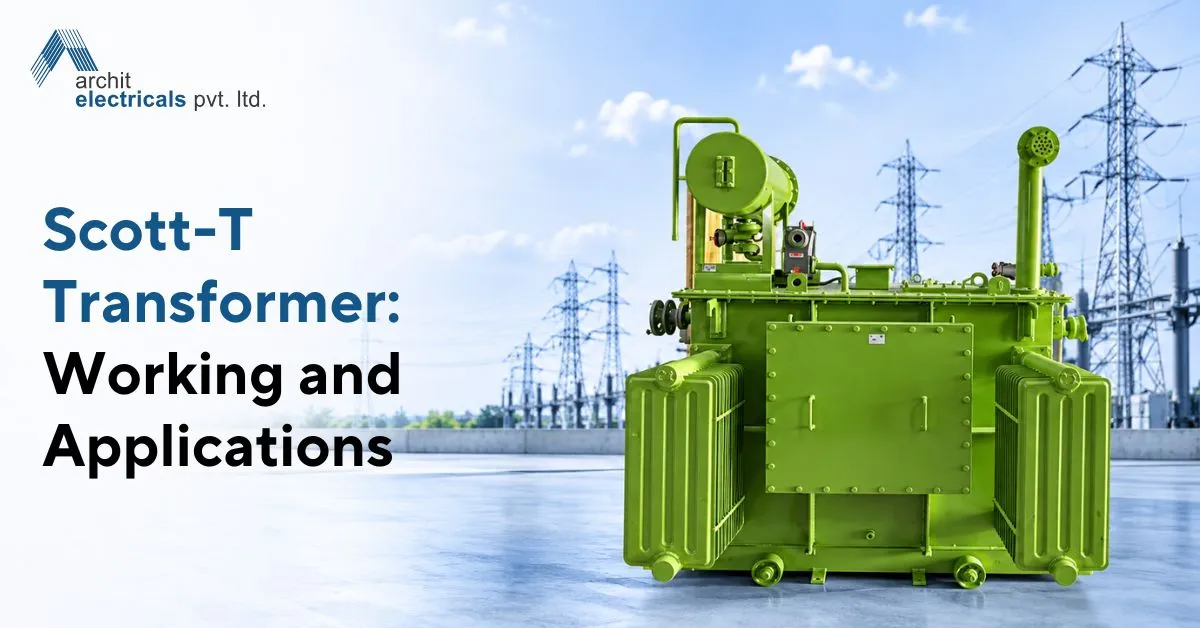
A Scott-T Transformer is a specialized transformer arrangement used to convert three-phase electrical power into two-phase power, or two-phase power into three-phase power. It is particularly useful where industrial equipment or specialized electrical systems require a different phase configuration from the available power supply. The arrangement uses two single-phase transformers, the Main Transformer and the Teaser Transformer, to achieve the required phase conversion.
What Is a Scott-T Transformer?
A Scott-T Transformer, also known as a Scott connection, consists of two electrically connected but magnetically independent single-phase transformers. The arrangement is designed to produce two output voltages of equal magnitude with a 90-degree phase difference when supplied from a balanced three-phase system.
This makes the Scott-T Transformer useful for industrial applications where two-phase power is required from a conventional three-phase supply. It can also be operated in the reverse direction to convert two-phase power into three-phase power.
Main Components of a Scott-T Transformer
The Scott-T Transformer primarily consists of two transformer units that work together to achieve phase conversion:
Main Transformer (T1)
The Main Transformer has a center-tapped primary winding. Its two outer terminals are connected across two phases of the incoming three-phase supply. The center tap provides the connection point for the Teaser Transformer.
The Main Transformer can use a 1:1 ratio or another required transformation ratio depending on the electrical application and desired output voltage.
Teaser Transformer (T2)
The Teaser or Auxiliary Transformer connects one end of its primary winding to the remaining phase of the three-phase supply, while the other end connects to the center tap of the Main Transformer.
A key feature of the Scott connection is the 86.6% or √3/2 relationship used for the teaser arrangement. This enables the two transformer outputs to achieve equal voltage magnitude and the required phase relationship.
How Does a Scott-T Transformer Work?
The working principle is based on the voltage and phase relationships within a balanced three-phase system. The Main Transformer receives power across two phases, while the Teaser Transformer uses the third phase and the center-tap connection of the Main Transformer.
The voltage relationship between these connections produces the required transformation between the three-phase input and the two-phase output. With the appropriate winding arrangement, the two output voltages have equal magnitude and are 90° apart in phase.
This precise phase relationship is what allows the Scott-T Transformer to provide a practical connection between three-phase electrical networks and two-phase equipment.
This is why a single maintenance procedure should not automatically be applied to every transformer.
Create a Transformer Maintenance Schedule
A Transformer Maintenance Schedule should be established according to the transformer type, operating conditions, load, environment, and applicable manufacturer recommendations.
A maintenance record should ideally document:
- Inspection date
- Transformer condition
- Observed abnormalities
- Testing performed
- Test results
- Corrective action
- Follow-up requirements
Maintaining these records helps teams track changes in equipment condition over time.
Looking for a Scott-T Transformer for a specialized industrial application? Contact us to discuss your electrical requirements and transformer configuration.
Scott-T Transformer Specifications to Consider
A Scott-T Transformer selection should be based on the electrical and application requirements rather than only the transformer size. Important considerations include:
- Input phase configuration – Three-phase supply requirements
- Output phase configuration – Two-phase output requirements
- Voltage ratio – Required input and output voltage levels
- Main transformer ratio – Based on the required voltage transformation
- Teaser winding relationship – The 86.6% arrangement is fundamental to the conventional Scott connection
- Power requirement – Determined according to the connected load
- Load balance – Important for maintaining suitable three-phase-side performance
- Application requirements – Industrial equipment and specialized systems may require different configurations
Applications of Scott-T Transformer
The ability to connect different phase systems makes the Scott-T Transformer suitable for several specialized applications.
- Electric Furnaces: Used where industrial furnace equipment requires two-phase power from a three-phase supply.
- Railway Traction Systems: Can be used in electrical traction systems requiring specialized phase conversion.
- Two-Phase Industrial Equipment: Helps operate equipment designed for two-phase electrical supplies.
- Legacy Electrical Systems: Provides a practical connection between older two-phase equipment and modern three-phase networks.
- Interfacing Different Power Systems: Useful where electrical systems with different phase configurations need to be interconnected.
Advantages of Scott-T Transformer
A properly designed Scott-T Transformer offers several practical benefits:
- Converts three-phase power to two-phase power
- Can provide reverse two-phase to three-phase conversion
- Produces two output voltages with a 90° phase relationship
- Can provide balanced loading on the three-phase side when properly designed
- Uses transformer-based phase conversion without rotating machinery
- Suitable for specialized industrial applications
Considerations Before Selecting a Scott-T Transformer
Before selecting a Scott-T Transformer, industries should evaluate the required voltage, power capacity, phase configuration, connected load, operating conditions, and specific application requirements. The transformer arrangement should be matched to the electrical system to ensure appropriate phase conversion and reliable operation.
A suitable design should therefore be selected according to the actual electrical system rather than treating every Scott connection as identical.
Important factors to consider include:
- Input and Output Voltage – Confirm the required voltage levels for the three-phase supply and two-phase equipment.
- Power Capacity – Select a suitable capacity according to the connected electrical load and operating requirements.
- Phase Configuration – Verify the required three-phase to two-phase or two-phase to three-phase conversion.
- Load Characteristics – Consider whether the connected loads are balanced or unbalanced.
- Operating Conditions – Evaluate continuous loading, installation environment, and expected operating conditions.
- Application Requirements – Consider the specific equipment or industrial process for which the transformer will be used.
- Transformer Design – Ensure the Main and Teaser Transformer arrangement is properly engineered for the intended system.
Frequently Asked Questions
It is primarily used to convert three-phase electrical power into two-phase power or to perform the reverse conversion.
A conventional Scott connection uses two single-phase transformers: a Main Transformer and a Teaser Transformer.
The two output voltages are designed to have a 90-degree phase difference, creating the required two-phase system.
They can be used for electric furnaces, railway traction systems, two-phase industrial equipment, legacy electrical systems, and applications requiring phase-system conversion.
Conclusion
A Scott-T Transformer provides a specialized method of connecting three-phase and two-phase electrical systems. Its Main and Teaser Transformer arrangement uses specific voltage and phase relationships to produce two equal-magnitude outputs separated by 90 degrees. With applications ranging from industrial furnaces and specialized equipment to railway traction systems, proper transformer selection and design are essential for reliable phase conversion and industrial operation.
Electrical TransformerIndustrial Transformer ManufacturerSpecial Purpose TransformerTransformer ApplicationsTwo Phase Transformer
Related Posts
Choosing the right transformer for an industrial application requires a clear understanding of its electrical…
Transformers are essential for reliable power distribution and industrial electrical systems. However, continuous operation can…