Skip to content
Map15, Jeevan Jyot Society, Opp.Indra Complex, Lalbaug Road, Vadodara-390011

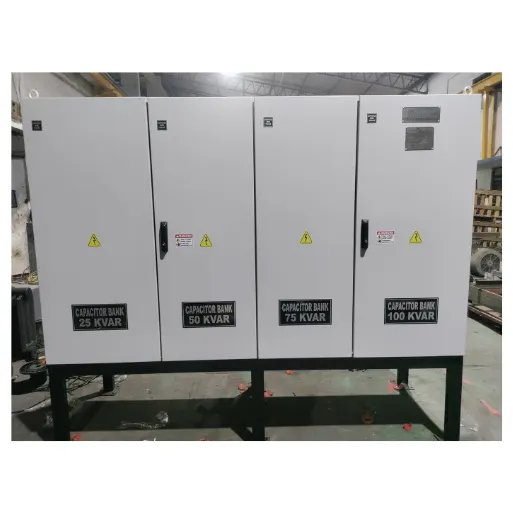
A capacitor bank is a group of capacitors connected together (in series, parallel, or a combination) to store and manage electrical energy. They’re widely used in power systems and industrial setups.

What it does

At its core, a capacitor bank helps with power factor correction. In many electrical systems — especially those with motors and transformers—power factor becomes low due to reactive power. A capacitor bank supplies this reactive power locally, which:

  • Improves power factor
  • Reduces electricity losses
  • Increases system efficiency
  •  Lowers electricity bills (important in industrial billing)

Where it’s used

You’ll commonly find capacitor banks in:

  • Factories and industrial plants
  • Electrical substations
  • Commercial buildings (malls, hospitals)
  • Large motor installations

Types of capacitor banks

  • Fixed capacitor bank: Always connected, supplies constant reactive power
  •  Automatic capacitor bank (APFC panel): Switches capacitors on/off automatically based on load
  •  HT (High Tension) and LT (Low Tension) banks: Used at different voltage levels

Simple analogy

Think of it as a clever way to “split” a 3-phase system into two perfectly timed waves that behave like a 2-phase system—without wasting energy or causing imbalance.
If you want, I can show a diagram or walk through the voltage relationships step by step.

Basic connection styles

  • Parallel connection → increases capacitance (most common in banks)
  • Series connection → used when higher voltage rating is needed
Back To Top